ENGLISH
Source: Tsingshan Group (Tsingshan Research Institute)
In recent years, the domestic plastic mold steel market has continued to expand, with annual consumption exceeding one million tons and an average annual growth rate of about 10%. Among them, 1.2311 (P20, 3Cr2Mo) and 1.2738 (718) are the most widely used traditional plastic mold steels globally. These products contain more than 0.15% molybdenum, have a tempered martensite microstructure, and achieve a pre‑hardened hardness of HRC 28 or higher.
Existing plastic mold steel products face three major technical challenges:
Leveraging its laterite nickel ore resource advantages, Tsingshan Group has developed a molybdenum‑free bainitic alloy design and process innovation, globally launching the low‑carbon nickel‑bearing bainitic plastic mold steel Q2311Ni. Compared with traditional plastic mold steels, this product offers superior hardness and microstructure uniformity, mechanical properties, machinability, and polishability.

Figure 1 Polishing effect of Q2311Ni mold steel
To address the industry pain points of traditional plastic mold steels, Tsingshan Group has innovated alloy composition and process flow. The core innovations are as follows:
Tsingshan Group has pioneered a plastic mold steel composition system based on laterite nickel ore, characterized by low carbon and molybdenum‑free content. The combination of chromium, nickel, and manganese alloying elements can replace molybdenum to control bainitic transformation, eliminating the need for off‑line high‑temperature tempering. The steel plate achieves a uniform bainitic microstructure and pre‑hardened properties (HRC 30‑35) across the entire cross‑section.
Table 1 Comparison of composition and hardness between Q2311Ni and traditional plastic mold steels (wt%)
| Grade | Standard | C | Si | Mn | Cr | Ni | Mo | N | Hardness /HRC |
|---|---|---|---|---|---|---|---|---|---|
| 1.2311 | DIN EN | 0.406 | 0.38 | 1.38 | 1.76 | 0.04 | 0.21 | / | 28~35 |
| 1.2738 | 4957 | 0.427 | 0.32 | 1.51 | 1.87 | 0.91 | 0.23 | / | 36~39 |
| Q2311Ni | Q/TTIG 018 | ≤0.15 | ≤1.0 | 1.0~2.5 | 3.00~5.00 | 0.80~2.00 | 0 | ≤0.01 | 30~35 |
To address the uneven microstructure and hardness across the thickness section caused by alloy composition segregation in continuous casting slabs, process parameters such as casting speed and superheat were optimized. An alloy composition segregation index was derived:
3.5×C + 4.5×P + (2×Mn)/6 + (1.3×Cr)/5 + Ni/15
Through the optimization of process parameters and the alloy composition segregation index, alloy segregation in the slab cross‑section is significantly reduced, creating favorable conditions for uniform microstructure and hardness distribution.
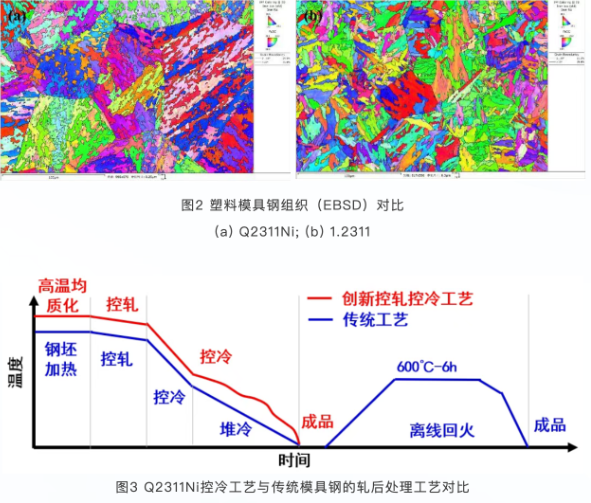
The cooling process after rolling is crucial for determining the properties and metallurgical quality of plastic mold steel. Based on phase transformation kinetics calculations and simulations, a post‑rolling controlled cooling process was developed to obtain a uniform bainitic microstructure and hardness distribution across the entire plate thickness.
| Process Type | Process Steps |
|---|---|
| Q2311Ni controlled cooling process | Slab → Heating → Controlled rolling → Innovative controlled rolling and cooling process → Stack cooling → Finished product (no off‑line tempering required) |
| Traditional mold steel process | Slab → Heating → Controlled rolling → Controlled cooling → High‑temperature tempering at 600°C (up to 20h) → Finished product |
Compared to the traditional process, Q2311Ni eliminates the need for long‑term high‑temperature tempering, improving production efficiency, reducing process costs, and lowering CO₂ emissions by 0.24 tons per ton of steel, achieving significant energy saving and emission reduction.
Based on the alloy design using laterite nickel ore, the segregation‑reducing continuous casting process, and the high‑temperature tempering‑free controlled cooling process, Q2311Ni plastic mold steel achieves excellent properties, as detailed below:
Through the "alloy composition‑controlled cooling process‑phase transformation microstructure" integrated hardness control model, the cross‑section hardness of 15‑120mm thick Q2311Ni steel plates remains between HRC 32‑34, with a maximum hardness difference ≤2 HRC. The uniformity of distribution is significantly better than that of traditional products.
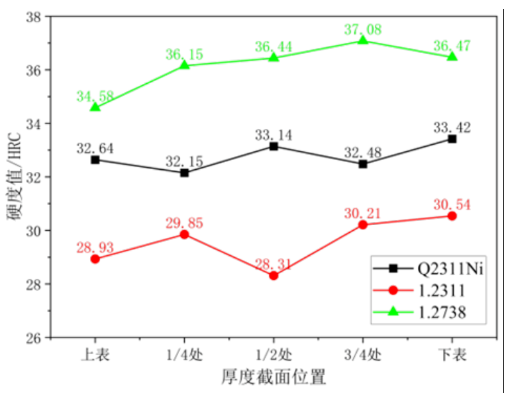
(Note: The original contains a line chart of hardness distribution; core data are extracted here.)
| Cross‑section position | Q2311Ni Hardness (HRC) | 1.2311 Hardness (HRC) | 1.2738 Hardness (HRC) |
|---|---|---|---|
| Top surface | 32.64 | 29.85 | 30.21 |
| 1/4 thickness | 33.14 | 30.54 | 32.15 |
| 1/2 thickness | 33.42 | 32.48 | 34.58 |
| 3/4 thickness | 32.15 | 36.15 | 36.44 |
| Bottom surface | 32.48 | 36.47 | 37.08 |
| Maximum hardness difference | 1.3 | 2.2 | 2.5 |
Note: The greater the plate thickness, the more pronounced the cross‑section hardness difference in 1.2311 and 1.2738, while Q2311Ni maintains a uniform distribution.
Compared with 1.2311 and 1.2738, Q2311Ni shows significant improvements in plasticity and toughness, machining efficiency, polishability, and mechanical properties:
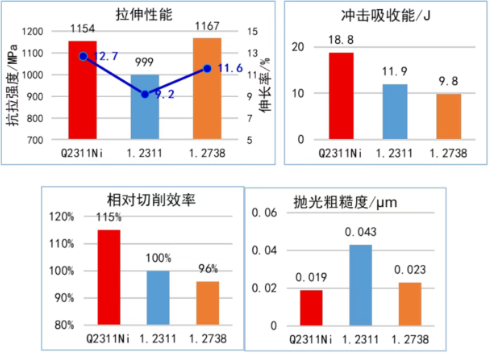
(Note: The original contains multiple performance comparison charts; core data are extracted here.)
| Performance Indicator | Q2311Ni | 1.2311 | 1.2738 | Improvement vs. 1.2311 |
|---|---|---|---|---|
| Tensile strength (MPa) | 1154 | 999 | 1100 | ~15% |
| Elongation (%) | 12.7 | 9.2 | 9 | 30% |
| Impact energy (J) | 18.8 | 11.9 | 9.8 | >57% |
| Relative machining efficiency | 115% | 100% | 96% | 15% |
| Polished roughness (μm) | 0.019 | 0.043 | 0.023 | 56% lower |
Using laterite nickel ore as raw material, Tsingshan Group has utilized the nickel, chromium, and manganese alloying elements to promote bainitic transformation. By reducing carbon content, eliminating expensive molybdenum additions, and employing a post‑rolling controlled cooling process, the low‑carbon nickel‑bearing bainitic plastic mold steel Q2311Ni has been successfully developed, achieving high performance, low cost, and low carbon emissions for plastic mold steels.
This product has been granted a product invention patent: "A Bainitic Plastic Mold Steel Based on Laterite Nickel Ore and Its Manufacturing Method" (Patent No.: CN202511409065.6), which will promote the high‑quality development of the plastic mold steel industry.